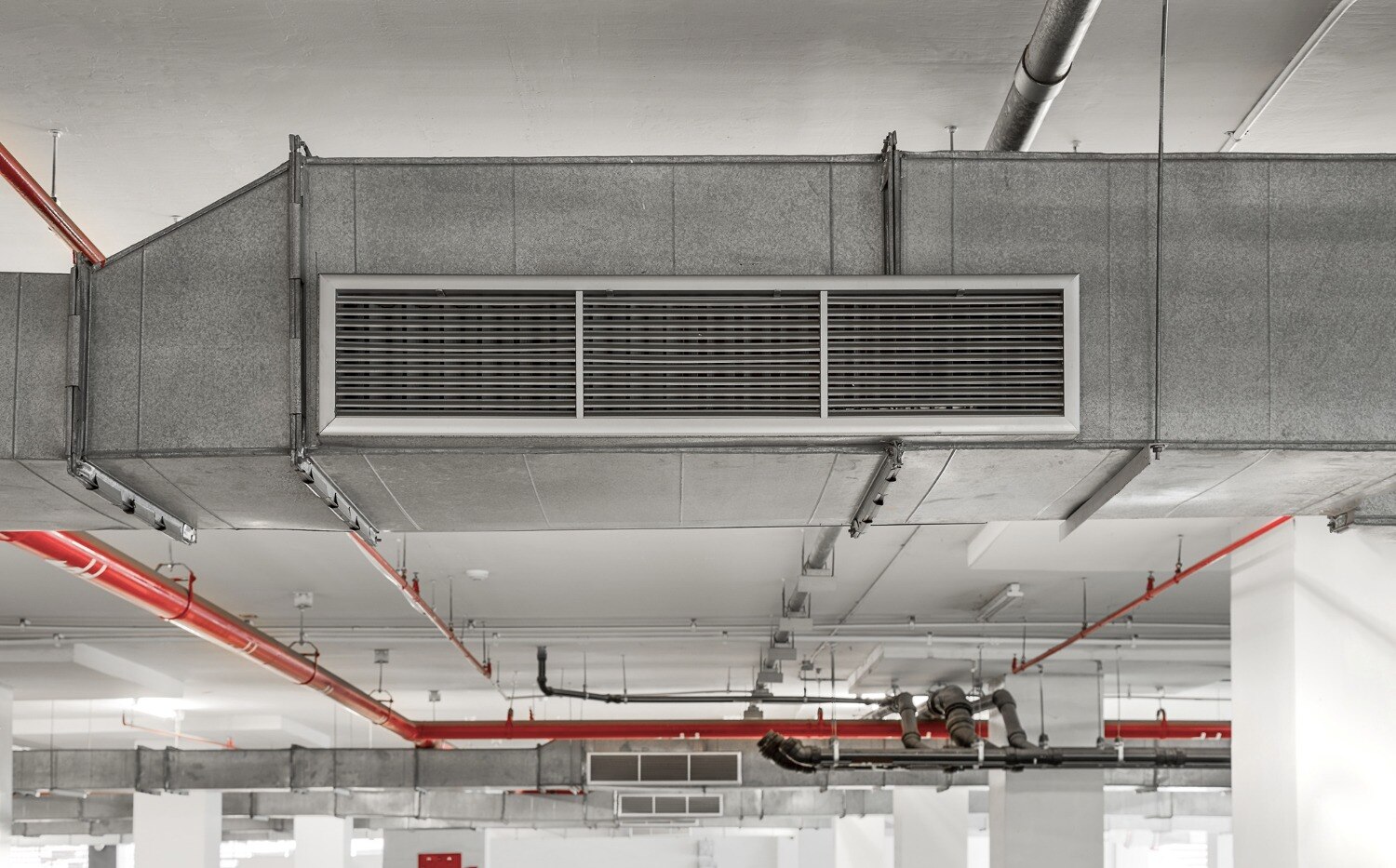
A hot, smoky or solvent-laden production area cannot be corrected reliably by increasing room air changes or installing a larger fan. You need to identify the emission source, capture it at the right location, replace exhausted air without destabilising the building, and verify performance under real production conditions.
Key takeaways
- Separate process heat, hazardous emissions and comfort airflow before choosing equipment.
- Capture fumes and dust at the source instead of diluting them across the room.
- Size exhaust with capture velocity, pressure balance and replacement makeup air.
- Match filters, cooling, sensors and controls to the specific process hazard.
Start by Separating Heat, Contaminants and Comfort Airflow
Classify the problem before selecting a fan, hood, filter, or cooling unit: determine whether the priority is process heat, a hazardous emission, or occupant comfort. These needs use different airflow paths and controls, and a high air-change rate can solve none of them.
| Problem | What to identify | Design implication |
|---|---|---|
| Heat | Source, surface and process temperature, released heat volume, radiant exposure, and outdoor-air condition | Heat-control ventilation must remove sensible heat where it is released; airflow alone will not eliminate radiant load or high humidity |
| Contaminants | Release point, emission volume, particle or vapour size, toxicity, temperature, and travel path | Contaminant-control ventilation needs source capture, suitable treatment, and safe exhaust |
| Comfort | Occupancy, air temperature, humidity, air movement, and outdoor-air requirement | Comfort HVAC manages people’s thermal conditions, not welding fumes, solvent vapours, or process dust |
Walk the area during representative production, not during an empty-room test. Mark each source, hood position, cross-draft, door, supply outlet, and pressure boundary; air should move from cleaner areas toward dirtier ones when containment matters. ASHRAE 62.1 outdoor-air rates do not replace process ventilation design.
Verify the diagnosis through hood performance, branch airflow, duct pressure, filter pressure drop, room pressure, alarms, and contaminant measurements. Industrial ventilation systems need commissioning evidence, not just a fan nameplate.
Capture Fumes and Dust Before They Reach the Room
Local exhaust ventilation removes fumes and dust at the point of release, before room air carries them through the breathing zone. Dilution ventilation spreads outdoor air across the whole space, reducing average concentration only after the contaminant has mixed with air. It does not prove that a worker avoided the plume.
Source capture depends on a hood’s enclosure, position and airflow, not on a nominal air-change rate. A hood placed close to a welding arc, grinding wheel or solvent tank creates capture zones that pull emissions into ductwork before cross-drafts carry them away.
A badly positioned hood can leave the source outside its effective zone while the fan still moves its rated airflow.
Use this procedure when selecting or checking the system:
- Identify the release point, emission direction, temperature, particle size and toxicity. A welding plume, solvent vapour and combustible dust need different control strategies.
- Position hoods as close to the source as production allows, and enclose the process where possible. Test for cross-drafts from doors, fans and supply diffusers.
- Verify airflow at the hood and along the duct, then confirm that filters, scrubbers and exhaust stacks suit the contaminant.
- Provide distributed makeup air. Excessive negative pressure can pull air through doors, disturb combustion appliances and weaken capture at the hood.
Keep the process room negative to adjacent clean areas when containment is required, with air moving from cleaner zones toward dirtier ones. For welding, solvent work or dust-producing machinery, dilution alone can leave hazardous peaks even when the room feels well ventilated.
Size Airflow Around Capture, Pressure and Makeup Air
The system works only when airflow reaches the contaminant at the hood and replacement air enters without disrupting that path. Size local exhaust from the source outward: capture velocity, hood design, hood distance, enclosure openings and cross-drafts determine whether fumes or dust enter the hood before reaching workers. A room air-change rate cannot prove capture.
| Design factor | What it controls | Failure if mis-sized |
|---|---|---|
| Capture velocity | Air movement into the hood’s capture zone | Emissions escape into the work area |
| Duct velocity | Transport of dust, vapour or fumes through the duct | Deposits, blockages or excessive noise develop |
| Pressure loss | Fan capacity across hoods, ducts, filters and stacks | Branches receive too little airflow |
Measure airflow at each branch, duct static pressure, filter pressure drop and hood performance under production conditions. A fan that delivers its rated volume only at zero resistance will not overcome the installed pressure loss.
Makeup air must replace exhausted air at a controlled rate and direction. Poorly distributed replacement air depressurizes the building, pulls drafts through doors and leaks, interferes with combustion appliances and can destroy hood capture. Excess exhaust also increases fan power and the cost of heating, cooling or dehumidifying incoming air.
Use variable-speed control only when minimum capture airflow and room-pressure limits remain protected; temperature or carbon-dioxide readings alone cannot confirm that.
Control Process Heat Without Depending Only on Colder Air
Colder air is only one part of heat control. Remove process heat at its source, block radiant transfer, and deliver air where workers need relief rather than flooding the entire building with airflow.
1. Map each heat source: machinery motors, furnaces, ovens, molten metal, heated tanks, and hot surfaces. Record surface temperatures, operating hours, heat release location, and whether the source produces a rising plume or spreads across the room.
2. Exhaust hot air at high-level hoods or enclosures when the heat rises naturally. Replace it with conditioned make-up air through deliberate supply-air distribution; uncontrolled replacement air can create drafts, depressurise the building, and weaken nearby capture systems.
3. Separate radiant heat from air temperature. Install radiant-heat shielding between workers and furnaces, hot vessels, or glowing surfaces, using reflective panels or insulated barriers with safe clearances. A cooler room does not prevent radiant exposure when a worker faces a hot surface.
4. Use spot cooling at fixed workstations, inspection points, and maintenance areas. Direct air movement across the worker can improve sweat evaporation, but high humidity limits that benefit; airflow alone will not solve heat strain in hot, humid outdoor conditions.
5. Check the energy cost before increasing exhaust. In IP units, Qsensible ≈ 1.08 × airflow (cfm) × temperature rise (°F), but this excludes radiant and latent heat. Use variable-speed controls only while preserving required capture and minimum ventilation conditions.
Match Treatment, Controls and Verification to the Hazard
Choose treatment from the contaminant’s physical form, toxicity, concentration and airflow, not from the fan size. A high-efficiency particulate filter removes particles; it does not remove solvent vapour, and a general-purpose filter does not make hazardous exhaust safe to recirculate.
| Treatment | Best fit | Main design check |
|---|---|---|
| Particulate filters | Welding fume, dust and aerosols | Particle size, pressure drop, filter loading and bypass |
| Activated carbon | Solvent vapours and other gases | Sorbent compatibility, capacity, breakthrough monitoring and replacement |
| Wet scrubbers | Soluble gases, acid mist and some particulates | Liquid chemistry, droplet carryover, corrosion and wastewater handling |
| Cyclones | Coarse, heavy dust before finer filtration | Particle size, collection efficiency and dust accumulation |
Combustible dust needs more than filtration. Identify its explosibility data, prevent ignition sources, control deposits in hoods and ducts, and provide collector isolation with explosion venting or suppression where the hazard assessment requires it.
Commissioning must prove capture at the source and containment in the room. Measure hood face velocity or capture velocity, duct airflow, fan static pressure, filter differential pressure and room-to-adjacent-area pressure. Use smoke or tracer testing to confirm that air moves from clean areas toward the process, not through doors or operator workstations.
Sample the actual contaminant at worker breathing zones and process boundaries during representative production. Compare results with the applicable occupational exposure limit, then repeat testing after filter loading or a process change. CO2 and ASHRAE 62.1 outdoor-air rates cannot verify control of solvent vapour, welding fume or combustible dust.
Arete Consulting Engineers can connect BAS alarms to airflow failure, high filter pressure and carbon breakthrough indicators, turning a hidden loss of control into an actionable fault.
Related products
HVAC Solutions HVAC stands for Heating, Ventilation, and Air Conditioning. It refers to the systems used for moving air between indoor and outdoor areas, along with... View product → |
Building Automation Systems (BAS) are advanced control systems that automate and monitor a building's mechanical and electrical systems, including HVAC, lighting,... View product → |
Frequently asked questions
Why is a high air-change rate not enough for manufacturing ventilation?
High room-air exchange does not reliably capture a contaminant at its source or remove process heat from the equipment producing it. Use local exhaust for emissions and dedicated heat-control airflow for hot processes.
How do you capture fumes and dust before they spread?
Place a hood or enclosure close to the emission point, connect it to correctly sized ductwork, and maintain enough capture airflow to pull the contaminant into the exhaust stream before it reaches the occupied zone.
What factors determine industrial ventilation airflow?
Size airflow around the hood’s capture requirement, duct and filter pressure losses, exhaust-fan performance, and the makeup air needed to replace removed air without disrupting capture.
How should a facility control process heat?
Remove heat at the source with equipment exhaust, enclosures, radiant barriers or process cooling where practical. Use general comfort cooling for the remaining room load rather than depending only on colder supply air.