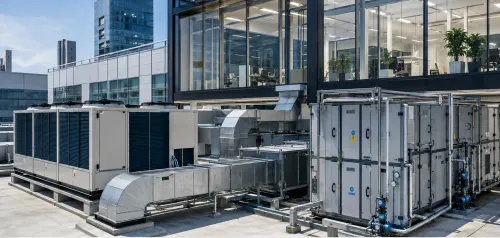

Perishable cargo facilities operate under a simple commercial reality. Temperature-sensitive goods can lose quality when environmental conditions move outside acceptable limits. Yet maintaining those conditions is technically challenging because products arrive and leave continuously, doors open frequently, and storage requirements can change between commodities.
This makes HVAC Systems for Perishable Cargo Centres an important part of cold-chain infrastructure rather than a conventional comfort-cooling requirement.
For facilities handling food products, flowers, pharmaceuticals, and other sensitive cargo around Bangalore and Karnataka, the engineering strategy should begin with the product journey through the building.
Map the Product Movement
Cargo does not remain in one room throughout the process.
It may move through unloading, inspection, staging, sorting, storage, packing, holding, and dispatch areas. Each stage can have different temperature requirements and exposure risks.
Mapping this movement helps identify where environmental control is most critical.
It can also reveal locations where doors, transfer points, and waiting periods could disrupt the temperature chain.
Temperature Zones Need Clear Separation
Different products may require different storage conditions.
Instead of forcing a single temperature across the entire facility, engineers can establish zones based on product requirements and operational use.
Zoning can also help reduce energy consumption because areas do not need to be maintained at unnecessarily demanding conditions.
The boundaries between zones need careful planning, particularly where doors open frequently.
Humidity Can Be Equally Important
Temperature is only one part of perishable cargo management.
Relative humidity can affect dehydration, condensation, packaging, product quality, and frost formation depending on the application.
The required humidity range should therefore be established from product and process needs rather than selected as a generic comfort condition.
Door Openings Create Significant Loads
Every time a cold area opens to a warmer environment, heat and moisture can enter.
High traffic can substantially increase refrigeration load and make stable conditions difficult to maintain.
Potential measures include:
- Rapid-closing doors
- Appropriate door sizing
- Strip curtains in suitable applications
- Air-lock arrangements
- Dock planning
- Traffic management
- Proper pressure relationships
Operational practices and engineering design need to support each other.
Redundancy Depends on Product Risk
A refrigeration failure in a normal comfort area may inconvenience occupants. A failure in a perishable cargo facility can threaten valuable inventory.
The need for standby capacity should therefore be assessed based on product sensitivity, storage duration, repair response time, equipment criticality, and operational risk.
Not every component requires full redundancy, but critical failure points should be identified deliberately.
Monitoring Helps Detect Problems Early
Temperature sensors, humidity monitoring, alarms, data logging, and building-management integration can provide useful visibility into facility performance.
Sensor locations matter. A reading taken near an air outlet may not represent the actual condition around stored products.
For cold-chain projects in Bangalore, Arete Consulting Engineers can address refrigeration and HVAC requirements together with electrical, MEP, controls, and building-service coordination.
Well-designed HVAC Systems for Perishable Cargo Centres protect the environmental conditions required throughout product movement. By considering zoning, humidity, infiltration, refrigeration loads, monitoring, redundancy, and operational practices together, project teams can develop infrastructure that supports a more dependable cold chain from receiving through dispatch.
Keywords