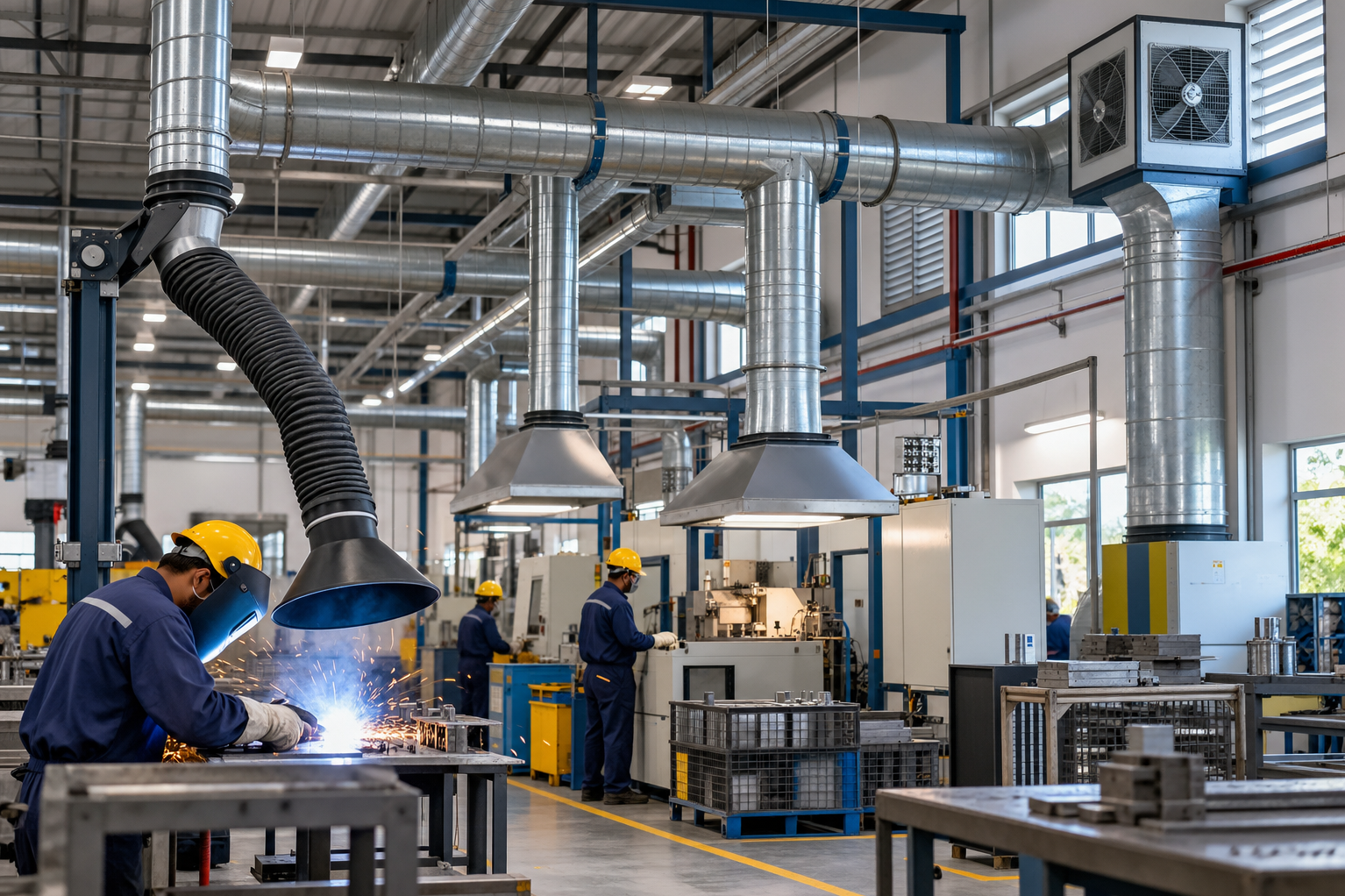
Heat, fumes, vapours, dust, smoke, and process emissions can quickly turn an industrial workspace into a difficult environment. Installing more fans may appear to be an easy response, but airflow without a clear engineering strategy can simply move contaminants from one part of a facility to another.
Properly engineered Industrial Ventilation Systems focus on where contaminants originate, how air moves through the building, and where replacement air will come from.
Manufacturing facilities in Bangalore and Karnataka can vary widely in process type, building configuration, and operating conditions, making a site-specific ventilation strategy important.
Start With the Source
The most useful question is often where the unwanted heat or contaminant is being generated.
If fumes originate at a workstation, capturing them close to that point may be more effective than ventilating the entire production hall at a very high rate.
Source-capture approaches can include hoods, extraction arms, enclosures, local exhaust points, and process-specific collection systems.
Their effectiveness depends on positioning, capture velocity, process movement, and interference from surrounding airflow.
General Ventilation Has a Different Purpose
Dilution ventilation introduces and removes air across a larger space.
It can be useful for managing heat and certain low-level contaminants where local capture is not practical. However, it should not automatically be treated as a substitute for source extraction where concentrated emissions need controlled removal.
A facility may require a combination of local exhaust and general ventilation.
Exhaust Air Must Be Replaced
One of the most frequent ventilation problems occurs when large exhaust systems are installed without sufficient make-up air.
The building can then operate under excessive negative pressure.
Possible consequences include:
- Uncontrolled outdoor-air infiltration
- Strong drafts
- Difficulty operating doors
- Reduced exhaust performance
- Dust entry through openings
- Unstable indoor temperatures
- Interference with adjacent conditioned spaces
A balanced design considers both extracted air and replacement air.
Fan Capacity Alone Does Not Define Performance
Selecting a larger fan does not automatically create a better ventilation system.
Duct resistance, bends, filters, hoods, dampers, grilles, equipment connections, and discharge arrangements all affect airflow. Fan selection should therefore be based on calculated air quantity and system resistance.
Noise, vibration, energy consumption, and maintainability should also be reviewed.
Discharge Locations Need Attention
Exhaust air should not be discharged where it can easily return through outdoor-air intakes, windows, doors, occupied areas, or neighbouring buildings.
This becomes particularly important on sites with several ventilation and HVAC systems operating simultaneously.
Engineers need to consider intake and exhaust locations during building planning, not only after equipment has been selected.
Controls Can Reduce Unnecessary Operation
Not every ventilation system needs to operate continuously at maximum capacity.
Depending on the process, systems can potentially be interlocked with production equipment, scheduled according to shifts, or controlled using suitable sensors and variable-speed drives.
Any demand-based strategy should still maintain required safety and environmental conditions.
For manufacturing and industrial facilities in Bangalore, Arete Consulting Engineers can assess ventilation alongside HVAC, electrical, plumbing, and wider building engineering requirements.
Effective Industrial Ventilation Systems are built around contaminant control, heat removal, balanced airflow, appropriate fan selection, safe discharge, and practical operation. When these elements are considered together, ventilation becomes a targeted engineering solution rather than a collection of fans added after workplace conditions become difficult.
Keywords