
HVAC performance is often judged only after a building becomes operational. Occupants notice uncomfortable rooms, facility teams notice high energy use, and contractors encounter coordination problems during installation. Yet many of these outcomes are determined much earlier during design.
Choosing suitable HVAC Design and Engineering Services means looking beyond equipment schedules and checking how thoroughly the design responds to the building, occupancy, climate, process, and operating strategy.
For complex projects in Bangalore, this evaluation can help architects, developers, contractors, and facility teams identify design gaps before they become expensive site problems.
Accurate Inputs Come First
HVAC design quality depends on the information used to develop it.
Before calculations begin, the engineering team should understand architectural layouts, building orientation, envelope characteristics, occupancy, lighting, equipment loads, operating hours, fresh-air requirements, indoor design conditions, and specialised process needs.
Unclear assumptions should be documented rather than hidden within calculations.
This becomes particularly important when projects evolve during design.
Load Calculations Need Project Specific Data
Cooling-load calculations should reflect actual project conditions.
Simply applying a fixed cooling capacity per square foot can overlook major differences between spaces. A conference room, hospital area, commercial office, server room, industrial production zone, and retail space may have completely different load profiles.
Reliable calculations help engineers avoid both excessive and insufficient capacity.
System Selection Should Follow Evaluation
There is no single HVAC system that suits every building.
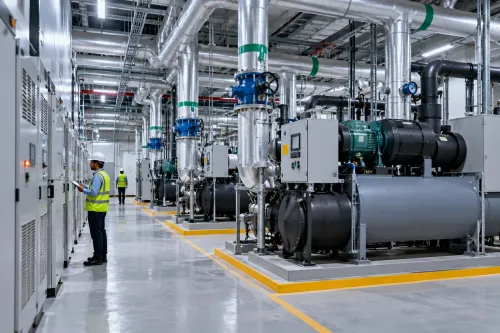
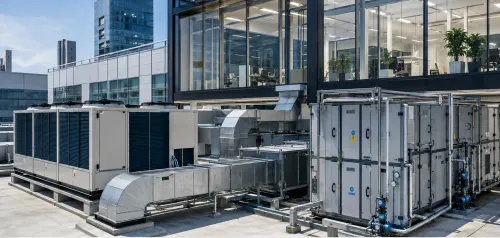
Depending on the project, options may include chilled-water systems, VRF systems, packaged equipment, air-handling systems, specialised ventilation, precision cooling, and combinations of technologies.
Evaluation should consider:
- Building size
- Occupancy pattern
- Operating schedule
- Zoning requirements
- Indoor environmental criteria
- Initial investment
- Energy performance
- Maintenance capability
- Plant-space availability
- Future expansion
The selected solution should reflect project priorities rather than technology preference alone.
Coordination Quality Can Be Reviewed Early
HVAC systems consume significant ceiling and plant space.
During consultant evaluation, project teams should ask how ductwork, piping, equipment, electrical services, plumbing, fire systems, architecture, and structure will be coordinated.
A technically correct duct layout can still fail on site if it conflicts with beams, cable trays, sprinklers, or ceiling requirements.
Multidisciplinary coordination is therefore a major part of design quality.
Controls Deserve Design Attention
HVAC controls determine how the installed equipment behaves after commissioning.
Sequences should address operating schedules, temperature control, pressure control where required, equipment staging, variable-speed operation, alarms, and integration with building management systems.
Controls that are unnecessarily complex can create operational difficulties. Controls that are too basic can waste energy and limit performance.
Documentation Should Support Construction
Good design documentation allows contractors to understand what needs to be built.
Drawings, specifications, equipment schedules, design criteria, schematics, control philosophies, and technical notes should communicate the engineering intent consistently.
When selecting HVAC Design and Engineering Services in Bangalore, project teams can also review the consultant's ability to support design development, coordination, tendering, contractor queries, and construction-stage technical decisions.
Arete Consulting Engineers provides MEP, HVAC, refrigeration, and building engineering consultancy for projects with varied technical requirements.
The strongest consultant evaluation is not based solely on who can produce drawings quickly. It examines whether the engineering process connects calculations, system selection, coordination, controls, documentation, construction practicality, and long-term operation into one coherent design.
Keywords