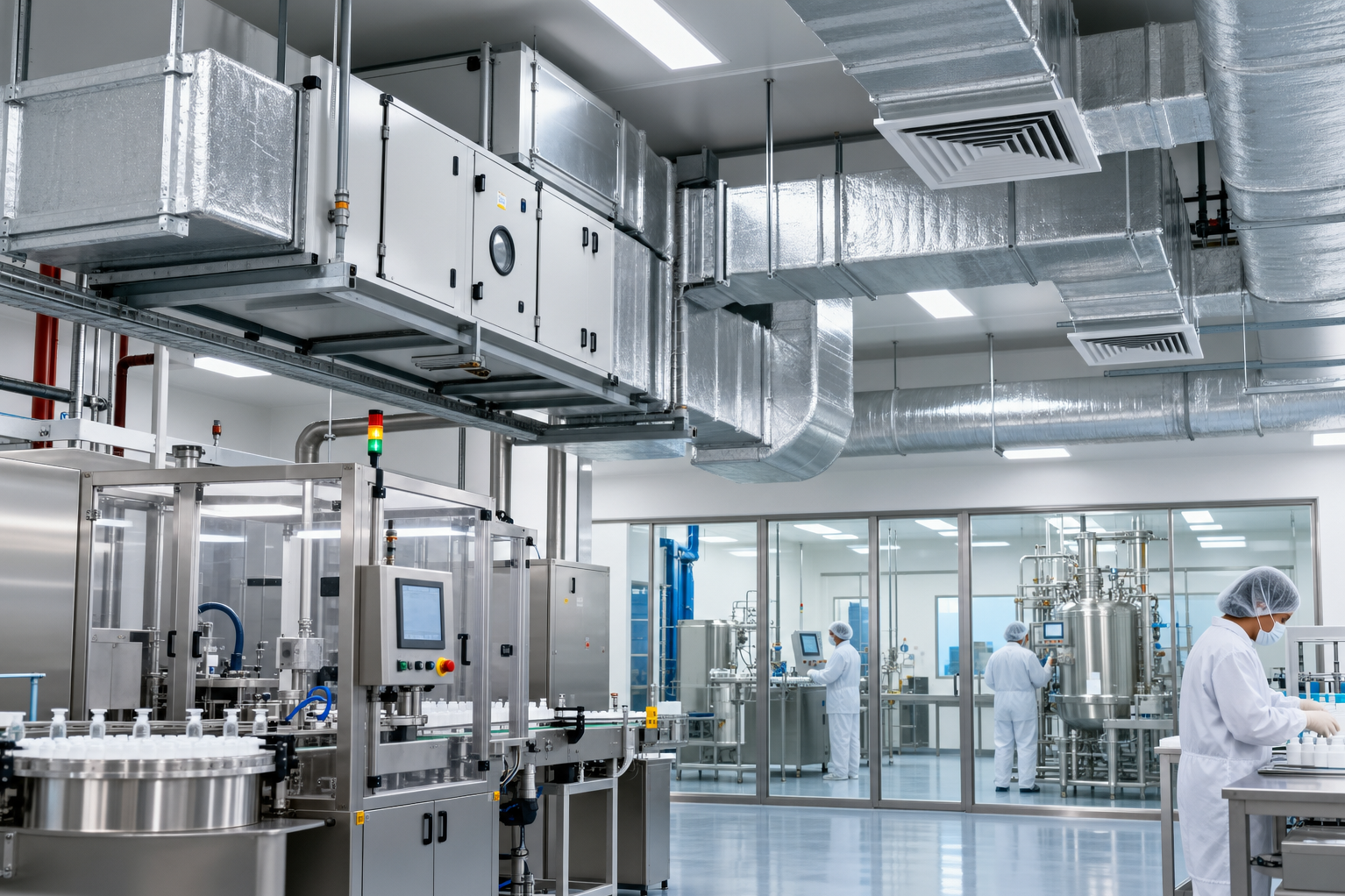
Pharmaceutical facilities depend on controlled environments, defined process conditions, contamination-control strategies, and documented performance. HVAC therefore becomes closely connected with production requirements and facility compliance rather than serving only as a comfort system.
Before developing HVAC Systems for the Pharmaceutical Industry, project teams should confirm that essential process information is available. Starting detailed engineering without these inputs can create repeated redesign, oversized equipment, unclear pressure relationships, and difficult validation later.
For pharmaceutical projects in Bangalore and Karnataka, a structured readiness review can make the design stage considerably more efficient.
Define the Manufacturing Process
The engineering team needs to understand what will happen in each room.
Process flow, material movement, personnel movement, equipment operation, cleaning procedures, and production schedules can all influence HVAC requirements.
A useful design brief should identify:
- Room functions
- Cleanliness classifications where applicable
- Occupancy
- Equipment heat loads
- Temperature requirements
- Relative humidity limits
- Exhaust requirements
- Pressure relationships
- Operating hours
- Future expansion plans
The more clearly these requirements are defined, the more accurately the system can be engineered.
Confirm Room Pressure Philosophy
Pressure relationships should be developed around contamination-control and containment objectives.
Certain clean spaces may need positive pressure relative to adjoining areas. Processes involving substances that require containment may demand a different pressure strategy.
A room-pressure matrix can help project stakeholders understand the intended cascade before detailed duct design begins.
This also provides a reference for controls and commissioning.
Establish Filtration Requirements
Filtration should be linked to process and classification needs.
Project teams need to define filter stages, terminal filtration where required, replacement access, testing provisions, and pressure-drop considerations.
Filters become progressively more resistant as they load, so fan selection and control strategies should account for realistic operating conditions.
Identify Exhaust and Containment Needs
Some pharmaceutical processes require dedicated extraction.
The design team should know which equipment or rooms generate dust, fumes, vapours, solvents, heat, or substances that should not be recirculated.
Exhaust requirements can significantly affect make-up air, room pressure, energy consumption, and equipment sizing.
They should therefore be established early.
Confirm Utility Availability
HVAC equipment depends on supporting infrastructure.
Electrical capacity, chilled-water availability, heating requirements, drainage, controls, building-management systems, plant space, shafts, ceiling space, and structural provisions all need confirmation.
A system cannot be designed effectively without understanding these interfaces.
Plan for Testing and Documentation
Pharmaceutical facilities often require extensive testing and documentation.
Design criteria, air quantities, pressure relationships, control sequences, equipment specifications, instrumentation, balancing provisions, and acceptance parameters should be clearly recorded.
This creates a more structured path toward testing, commissioning, and facility qualification activities.
Check Maintenance Access Before Freezing Layouts
Filters, coils, fans, valves, dampers, sensors, and other components need servicing throughout the facility lifecycle.
Plant rooms and ceiling spaces should provide enough access for routine maintenance and eventual replacement.
Arete Consulting Engineers supports HVAC, MEP, refrigeration, and building engineering requirements for technically demanding projects in Bangalore.
A pharmaceutical HVAC project is ready for detailed engineering when process requirements, classifications, pressure philosophy, filtration, exhaust, utilities, controls, maintenance, and testing expectations are sufficiently defined. Establishing these inputs early helps HVAC Systems for the Pharmaceutical Industry move from assumptions toward measurable engineering requirements.
Keywords